
Strive’s SATS: How 15% Yield Becomes A Bitcoin Accretion Machine

Strive’s newly IPO’d SATS perpetual preferred stock introduces an interesting opportunity: the company could potentially issue preferred equity above its $100 stated amount and grow Net Bitcoin Per Share (Net BPS) in each issuance round, subject to risks and parameters described below. This article discusses how and why it works. The key question is whether […]
Understanding Digital Money and Digital Yield

The new business model of building on top of digital credit to create digital money and digital yield can be roughly categorized into two different architectures. This article gives a general overview of these models, with an analysis of economic implications. Digital Credit, Digital Money and Digital Yield To get started, I will define these […]
Impacts of Daily Dividends on Digital Credit

In May 2026, Strive rebranded itself as “The Daily Dividend Company,” then moved SATA to daily cash dividends beginning June 16. Strategy has now pushed the same idea into its own digital credit engine. On September 24, its board proposed moving STRC, STRF, STRK and STRD to daily dividends, subject to shareholder approval at an […]
Quick Maths On STRC Buybacks: The Truth About Net Bitcoin Per Share and Accretion

Strategy initiated open-market repurchases of STRC last week (July 20 through July 26, 2026), buying 288,930 shares for ~$25 million at an average price of $86.52. Notably, the company bought no Bitcoin and continued to grow its cash reserve. So what is going on here? Why is the largest Bitcoin treasury company buying back its […]
Upgrading Digital Credit In 3 Steps

The latent tail risks in digital credit are clearer after June 2026. Read our post-mortem analysis of the June crash here. Given these recent events, this article is a proposal on what can be done to upgrade digital credit. Context about market behaviors and credit investors First—since the goal is to sell to credit investors—let’s get into […]
Crash Post Mortem – What Happened to STRC in June 2026
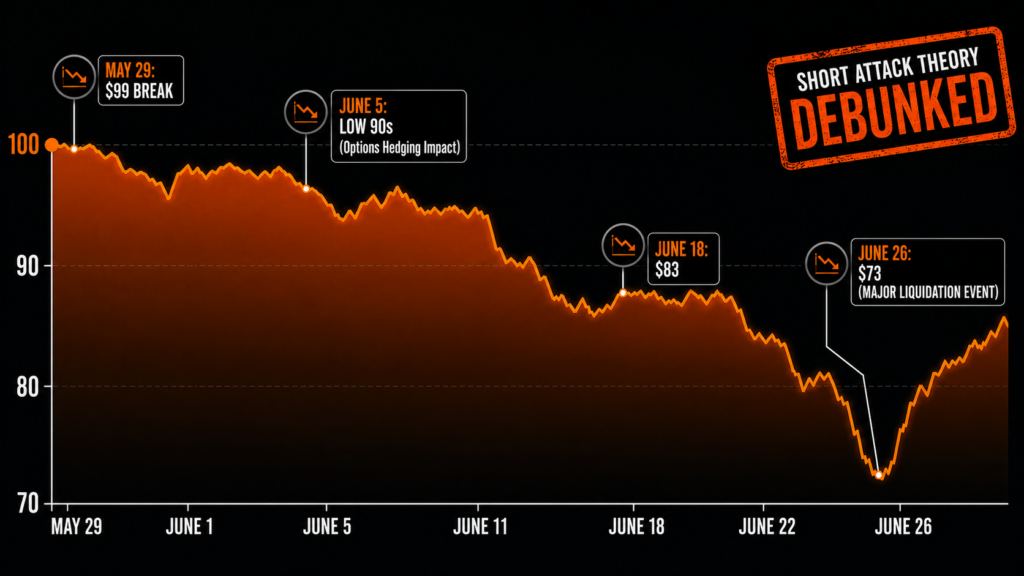
The Leveraged Setup (Important Context) Something paying 11.5% while promising to stay at par will attract leverage to squeeze out more returns. This is likely done using margin in brokerage accounts. There are also a number of DeFi protocols that are doing things to this effect (Saturn, Apyx, and auxiliary looping ecosystem). STRC was the […]
Quant Framework for Digital Credit Risk

Abstract Digital credit instruments—exchange-listed, perpetual preferred shares backed by Bitcoin-heavy corporate treasuries (e.g., STRC, SATA)—have grown rapidly, yet traditional risk models rely on subjective statistical assumptions. This paper introduces an objective, quantitative framework that decomposes digital credit yield into three components: the risk-free rate, the market-implied cost of hedging Bitcoin price risk, and a residual […]
Q1 2026 Corporate Bitcoin Report

Abstract Corporate Bitcoin adoption in Q1 2026 became significantly more concentrated and uneven, with total public holdings increasing by 69,480 BTC—a figure entirely supported by Strategy’s 89,602 BTC accumulation. Excluding Strategy, the public sector was a net seller of approximately 20,100 BTC, primarily driven by a 25,375.9 BTC liquidation from Bitcoin miners. These miners, including […]
Corporate Bitcoin Adoption 2026 Report

Abstract Abstract: Corporate Bitcoin Adoption 2026 Report The 2025 shift from simple accumulation to the securitization of BTC demonstrates that corporate demand is increasingly financing-enabled via capital markets tools like ATMs, PIPEs, and convertibles. While public companies added approximately 494,000 BTC , the emergence of “Digital Credit“—specifically multi-series perpetual preferred equity—has bifurcated the market into […]
S&P Rating on Strategy: Overview, Implications, and Industry Direction

Abstract The S&P rating on Strategy shows that when bitcoin is fully deducted from adjusted common equity, total adjusted capital turns negative and the rating is forced to anchor on weak capitalization. That outcome is predictable under the 2024 RACF and 2025 hybrid criteria. The practical takeaway for issuers seeking higher credit ratings is to […]